Saturday, August 18, 2018
A Revolutionary Book that offers answers to so many unanswered questions.
Wednesday, May 9, 2018
HPT Method of trimming Challenges Traditions
Here is a link to a video highlighting two trimming techniques. Even though this video was produced in 2007 the basics remain the same. Both trimming techniques have been around a long time.
For anyone interested in exploring AEP and the HPT Method attending a hands-on course is a great start. I think it is important to know that this method has been taught to thousands of concerned horse owners and professionals for nearly 20 years. The HPT Method was included in an article published by the American Farriers Journal in November of 2002. The article was a review of the seven most common trims being taught around the world at that time. This method has stood the test of time and continues to help increase the quality of life our horses experience. I hope to see many of you at a hands-on course in the future. Best wishes.
Sincerely, KC La Pierre
Friday, February 17, 2017
Hoof and Foot development
Tissues are grouped into three types, according to the rate they respond to change: Soft Tissue, Dynamic Tissue, and Static Tissue.
About the author: Penny Thorpe, DAEP came across Applied Equine Podiatry whilst working for two trainers who were clients of Trevor Jones DAEP. Curiosity to know a 'bit more about feet' led to a fascinating journey of study with the Institute, graduating as a DAEP in 2013 and starting second level study in 2014. She lives in Brighton with her family and is privileged to have a small practice of dedicated owners and lovely horses.
Wednesday, February 8, 2017
Re-writing the book on Chronic Laminitis
It has been some time since I last posted to this blog and I apologize to my followers. I have been busy promoting my new book "Laminitis, Founder, and Equine Digital Osteoarthritis".
The research required for the book has taken me to distant shores and far away places in the virtual world of academia. The title of this blog post is Re-writing the book on Chronic Laminitis and that is precisely what this new book does. I have presented glimpses of my work during lectures I presented at the University of Paris. In that talk I called for a change in perspective and a shift in paradigm. I suggested that research into the causes of chronic laminitis may be flawed because of the model that researchers subscribe to. The model that I am referring to is that of suspension. For decades research has been done following the premise that the lamellae attachment and subsequent loss of suspension of the distal phalanx was due to this tissue's degradation and that this loss defined the disease.
Entertaining a new model for the suspension of the distal phalanx is.... A real game changer!
Over the past fifteen years we have proposed that the lamellae in and by themselves are not capable of suspension, this due to the fact that they have little to no elastic potential. It was back in 2002 that we conducted a study to define a hoof model that we have since used for research and teaching at the Institute, ultimately allowing us to literally re-write the book on chronic laminitis.
Adopting a new model for suspension has allowed us to develop studies that have provided evidence to support exploration of new treatments, both pharmacological and practical.
Our latest study, a histological comparison study has opened up new possibilities and shows great promise in helping to change the focus of current research.
This revolutionary book may be purchased by following this link: https://appliedequinepodiatry.org/product/laminitis-founder-equine-digital-osteoarthritis-diagnosis-and-treatment/
Monday, January 16, 2017
USDA on Soring
The USDA has released their decision regarding the proposed changes to the Horse Protection Act. The language in the Act has been changed to apply to Tennessee Walking Horses and Racking Horses. Spotted Saddle Horses "and related breeds" have been removed from the proposed regulation.)
USDA Announces Changes Aimed at Ending the Inhumane Practice of Horse Soring
January 13, 2017--WASHINGTON-- The U.S. Department of Agriculture’s (USDA) Animal and Plant Health Inspection Service (APHIS) today announced a final rule that includes changes that will help to protect horses from the cruel and inhumane practice known as soring and eliminate the unfair competitive advantage that sore horses have over horses that are not sore. The practice of soring is intended to produce a high stepping gait through the use of action devices, caustic chemicals, and other practices that cause horses to suffer, or reasonably be expected to suffer physical pain, distress, inflammation, or lameness while walking or moving.
APHIS enforces the Horse Protection Act (HPA), a Federal law that makes it unlawful for any person to show, exhibit, sell, or transport sore horses, or to use any equipment, device, paraphernalia, or substance prohibited by USDA to prevent the soring of horse in such events. APHIS works actively with the horse industry to eliminate such inhumane practices and the resulting unfair competition they create at HPA-covered events.
The final rule addresses recommendations made by the USDA’s Office of Inspector General following an audit of APHIS’ horse protection program, which found the existing industry-led inspection program to be inadequate for ensuring compliance with the HPA. The rule also seeks to address the substantial noncompliance that continues to exist among Tennessee Walking Horses and racking horses and the relationship that continues to exist between the use of certain prohibited items and soring in horses, such as the use of permitted action devices alone or in conjunction with prohibited substances.
Under the final regulation—
• APHIS will license, train, and oversee independent, third party inspectors, known as Horse Protection Inspectors (HPIs), and establish the licensing eligibility requirements to reduce conflicts of interest.
• To allow sufficient time to train and license HPIs and ensure an adequate number before the start of the 2018 show season, current Designated Qualified Person (DQP) licenses will remain valid until January 1, 2018. Beginning January 1, 2018, management of horse shows, exhibitions, sales, and auctions that elect to use inspection services, must appoint and retain a HPI to inspect horses.
• Beginning January 1, 2018, the regulatory provisions applicable to Horse Industry Organization and Associations are removed and are no longer effective.
• Beginning 30 days after the publication of the final rule, all action devices, except for certain boots, are prohibited on any Tennessee Walking Horse or racking horse at any horse show, exhibition, sale, or auction. All pads and wedges are prohibited on any Tennessee Walking Horse or racking horse at any horse show, exhibition, sale, or auction on or after January 1, 2018, unless such horse has been prescribed and is receiving therapeutic, veterinary treatment using pads or wedges. This delayed implementation allows ample time to both gradually reduce the size of pads to minimize any potential physiological stress to the horses and prepare horses to compete in other classes.
• Beginning January 1, 2018, management of HPA-covered events must, among other things, submit certain information records to APHIS, provide HPIs with access, space, and facilities to conduct inspections, and have a farrier physically present to assist HPIs at horse shows, exhibitions, sales, and auctions that allow Tennessee Walking Horses or racking horses to participate in therapeutic pads and wedges if more than 150 horses are entered, and have a farrier on call if 150 or fewer horses are entered.
Congress passed the HPA to end the cruel and inhumane practice of soring horses and stop unfair competition. Strengthening the HPA regulations and the enforcement of alleged violations is the best way to achieve this goal. In addition, the prohibitions on the use of action devices and pads (with certain exceptions) are consistent with recommendations made by the American Veterinary Medical Association, the American Association of Equine Practitioners, and leading industry standards for equestrian sports.
This final rule will be published in the Federal Register in the coming days.
The changes regarding the prohibitions on the use of action devices and associated lubricants for exhibitors of Tennessee Walking horses and racking horses, along with the training and licensing of inspectors will be effective 30 days after publication in the Federal Register. The rest of the rule will be effective January 1, 2018.
Monday, March 7, 2016
Flat foot? Concavity and Health
If you are dealing with less than ideal conformation of the coffin bone do your homework on foot function.Monday, February 22, 2016
Expanding on Expansion, Hoof Function
Tuesday, February 16, 2016
Why Pad the Hoof?
This pressure is consistent across the entire solar aspect of the hoof capsule with little rebound, this due to the closed-cell formulation that exists within the pad. A regular foam or rubber pad that has too much rebound (or give), when put into motion with a moving horse, cannot provide consistent and correct support. Even and systematic pressure is what makes the Sole Mate pads unique. Increase in sole depth, hoof height, and frog growth is directly related to the application of correct stimulus. Correct exercise, working within the boundaries set by an honest assessment with the Spectrum of Usability can greatly improve the rehabilitation of all horse’s hooves. Without the use of these pads, the progressive next step, a sand arena, may be too harsh for the existing structures, especially if you are dealing with white line stretch, white line disease, or frog infection. Sand can erode and deteriorate these already sensitive structures, let alone cause irritation to an already deep central sulcus of the frog. Which pads do I choose for my horse? The Solemates Therapeutic Hoof pads range in three densities: four pound, six pound, and nine pound. We found it necessary to break down the pad use to less than 1200 pounds for the six, and 1200 pounds and over for the nine. However, if your draft or heavily-boned horse has very weak structure and exhibiting pain, wewould recommend using the six. You may not get as many uses out of the 6 lb pads with a draft horse in that state. However, we don’t want to cause undue stress on the foot either. So use your best judgment. The four pound pads are great for that mini horse in your barn, or any acute stages of laminitis. Why is it so important to specify weight? The pad has a unique characteristic that allows the pads to return to their near natural shape and size after use. If your horse is heavy or lands excessively in the toe due to caudal heel pain, it will exceed the life of the pad; or rather the pad will not be reusable. For years, the farrier sciences have been using a styro-foam pad that is supplied from the local lumber yard or Home Depot. Structural styro-foam is not only not reusable (costly), but crushes down to a hard, stagnant, substance that can cause bruising to the delicate structures (pressure necrosis). Pressure necrosis is a bruising of the capillaries at the corium level due to excessive force on the foot Sole Mates Therapeutic Hoof pads have the unique ability to consistently support the foot through the entire stride phase. Once the Sole Mates pad is removed, the imprint of the foot and hoof are astounding. The detail in the print much resembles that of a sand imprint on the beach where each intricate structure is delicately etched out.This type of detailed support is what makes the Sole Mate Hoof Pads priceless to anyone practicing hoof care. Once the structures begin to return to proper conformity, pin pointing additional structures like inner wall or transitioning to sand can be achieved safely.
Monday, February 8, 2016
Cracking the Code to Hoof Cracks
I have said it more times than I can remember, if the
mechanism for producing a healthy Matrix is comprised, then no supplement,
drug, or dressing is going to help alleviate hoof wall failures. Sure you can
attempt to hold it all together with a horseshoe, quarter clips, staples,
acrylics, and a host of other products developed as Band-Aids for the dreaded
hoof wall crack, but until the mechanism for the development of a healthy
matrix (balanced dynamic distortion) is returned you are simply placing a
finger in the dyke so to speak. Monday, February 1, 2016
What Hoof Model do you use?
![]() |
| Feral Abaco Barb |
![]() |
| Shoeless |
Tuesday, January 26, 2016
Weighing in on Obesity and Applied Equine Podiatry
Obesity is not a condition usually associated with hoof care. It is however, a major cause of Deformed Hoof Syndrome (DHS) and loss of proper foot function. Many of today's horses suffering hoof ailments are often overweight.
How do we define the obese horse? The obese horse is one that is 150 to 200 pounds over its recommended weight, this determined by weight tape and the application of the Body Condition Scoring System (BCS).
The BCS System
Score of 1(poor) to 9 (Extremely Fat)
Developed by Henneke et al in 1983 at Texas A&M
Used throughout the horse industry as standard score system
Accepted scientific method
Admissible in court
How it is done
Focus on 6 key areas:
Neck
Withers
Spinous process
Tail head
Behind the shoulder
Ribs
The system utilizes Visual Appraisal and Hands On /Palpation of those areas exhibiting fat deposits listed above.
As a Applied Equine Podiatrist I am concerned with horses that score 7 or higher on the BCS.
![]() |
| BCS 7 |
May have crease down back. Individual ribs can be felt, but noticeable filling between ribs with fat. Fat around tailhead is soft. Fat deposits along withers, behind shoulders and along the neck.
![]() |
| BCS 8 |
Crease down back. Difficult to palpate ribs. Fat around tailhead very soft. Area along withers filled with fat. Area behind shoulder filled in flush. Noticeable thickening of neck. Fat deposited along inner buttocks.
![]() |
| BCS 9 |
BCS 9
Obvious crease down back. Patchy fat appearing over ribs. Bulging fat around tailhead, along withers, behind shoulders and along neck. Fat along inner buttocks may rub together. Flank filled in flush.
Monday, January 18, 2016
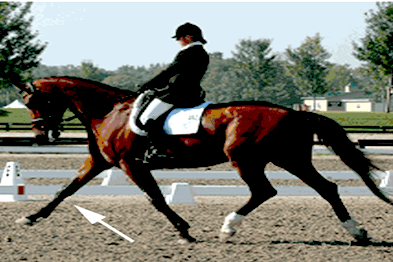
Weighing in on Leg Action
The following text is from an email I received concerning shod vs. barefoot.
Hi
I have an 11-year-old Lusitano stallion that is working towards Grand Prix dressage.
I have owned him since he was 3 years old and he has never had shoes on.
My farrier says he has the best feet of any horse he has ever seen. So far so good, but my dressage trainer, a Grand Prix rider from Holland, is insisting that I must put shoes on him.
He says that it will improve his front leg action making him lift his legs higher in movements like passage.
Is he right?
Wouldn't it only be a temporary reaction to the weight of the shoes?
The numerous downsides surely outweigh the possibility of more action.
I respect my trainer but I really don't want to put shoes on him, but my trainer can't understand why not.
I would love to hear any comments you might have please?
Kind regards
Rosie
From the UK
My response:
Dear Rosie,
Weight does have a huge effect on limb action, and yes, the weight of the shoe can alter gait. I have been a farrier for over three decades and in my earlier years, I worked on many Standardbred horses (Trotters and Pacers) using weight to alter or improve gait. Yes, I did say improve gait. I did not say improved biomechanics with the welfare of the horse in mind.
There are other means of achieving the goals your trainer has set. When we wanted to alter movement of the limb in the race horse (Trotter), we would use weights such as toe weights, side weights, or heel weights. A strategically placed 2 oz. weight would have adequate influence over foot flight, likely more so than a horseshoe placed balanced about the foots' axis. These hoof weights are available from several suppliers via the internet. Your trimmer should also be able to use their imagination to develop weights that would be less conspicuous on the hoof.
These weights should be applied to the lower outer hoof wall with glue, or screw, where desired. This type of weight is far less detrimental to foot function, but be advised, anytime you attempt to alter limb movement, you are creating strain that could lead to lameness. In addition to weights, there are horseshoes that offer needed elastic potential for better foot function, one such shoe is the titanium horseshoe.
In addition to weights, some trainers use weighted bell boots to help in developing muscle and muscle memory. Proper exercise, targeting the appropriate muscle groups goes a long way in releasing a horse's potential. See photos above.
I hope this information will be useful, pointing out that there are always alternatives to the traditional ridged shoe.
Keith "KC" La Pierre, MAEP, APR, RJF, CF, MIAEP
Monday, January 11, 2016
Immobilization or Stabilization?
When it comes to the hoof capsule, stability defines its health. The hoof wall is a matrix of epithelium and within that matrix are primary tubules originating at the coronary band and laminar derived inter-tubular horn originating at the lamellae.
The ratio of tubule to lamellae derived horn defines the walls primary function at any given location in the hoof wall. For example: The toe region of the hoof capsule has a high ratio of primary tubules to that of laminar derived horn, this when compared to the heel area of the hoof capsule. Primary tubules resist distortion, whereas lamellae derived horn is well suited to distortion and buffering. You see primary tubules provide the stability to the matrix much like re-bar to concrete. Primary tubules produced a the coronary band are quite dense.
Foundation, Foundation, Foundation
We must look to the foundation of a structure to truly understand the why of its make-up. The foundation of the toe is the coffin bone, where as the heel has a foundation of cartilage. It is a fact that the foundation of the caudal (back) hoof is cartilage and the foundation for the dorsal foot is bone. With a high ratio of tubules to lamellae derived horn in hoof wall surrounding the coffin bone we can deduce that the function of the toe is one of support and protection. Not physical support, but rather to support locomotion. Protection comes in the form of stabilization, helping to reduce torque about the coffin bone and with a layer of lamellae derived horn between the coffin bone and the hoof wall matrix a buffer is created to protect the dermis.
Looking at the heels we find a foundation of cartilage. The hoof wall in the heel has a matrix comprised of a high ratio of lamellae derived horn to that of primary tubules. This ratio allows for distortion to occur in the caudal foot, while protecting the dermis by way of buffering the shock created at impact.
Why do we want distortion in the caudal foot?
The simplest of answers is; because of the foundations of the foot. Cartilage throughout the body is often present to protect bone and this is true of the Ungular Cartilages of the equine foot. Cartilage health plays a major role in protecting the coffin bone and navicular apparatus from torque.
How did I come to this conclusion? By asking another simple question: Whys is the frog a triangle? Or Why is the Frog Stay a "V". As I stated earlier function is defined by a structures conformation and the property of its tissue. The foundation of the frog stay (inclusive of the bars) is essentially Ungular Cartilage. When I lectured at the National Farriers Conference in Normandy France I presented an analogy to help explain the function of the Ungular Cartilages.
I related the coffin bone to a tow vehicle and the ungular cartilages as a horse box (trailer). The union of the cartilage to bone was portrayed as a hitch with stabilizer bars. The function of the trailer hitch was to reduce or eliminate torque on the vehicle. The stabilizer bars (springs) provided elastic potential to stabilize movement and further reduce uncontrolled movement on the vehicle. Cartilage has the same function. Having a high elastic potential cartilage effectively reduces torque on the coffin bone and the navicular apparatus. I pointed out that stabilizer bars allow for optimal performance in towing and if they are removed excessive movement can occur placing strain on the vehicle. I also pointed out that if the hitch was to be welded solid the vehicle would be exposed to extreme torque and strain. I know this is a simplistic way of looking at function, but it often helps my students understand the difference between Stabilization, Instability, and Immobilization.
With this understanding my students are able to evaluate the vast array of bar shoes, flexible shoes, pad, and boots being used on horses today.

A foot stricken with instability due to weak cartilages will not do well in a flexible horse shoe, simply because unrestricted movement can be detrimental. Such a foot will not do well in a bar shoe either. The reason; because cartilage needs pressure to maintain or return health. Cartilage does not derive its nourishment directly from the circulatory system, so increasing circulation by loading the frog or allowing for expansion does not suffice. Cartilage needs to be stabilized not immobilized. How is this done? By providing stability through support with elastic potential. There are many products out there that can provide dynamic stability through elastice potentional to the weak hoof, using titanium shoes or steel (spring) shoes are two ways. The product pictured is Perfect Hoof Wear, a polyester wrap. Our students learn that an unstable foot can be stabilized by using the PHW and adding a flexible horseshoe to the wrap for performance.