Monday, December 22, 2014

Balance, Bottoms Up!

Balance remains a hot topic, regardless of where the conversation begins with break over, toe placement, or heel placement. It really doesn't matter, the topic is hot. It has been a hot topic for over 100 years.
In the late 1800’s, farrier professor William Russell offered many concepts on locating or visualizing the position of the distal phalanx within the hoof capsule. While Russell referenced many structures on the bottom of the foot, most farriers simply focused on the outer hoof wall. Russell felt that measuring back from the trimmed frog apex about ¾” (19mm) would put you in the center of the horses foot, and you could balance your trim or a shoe around that location. More recently, farriers David Duckett and Gene Ovnicek used similar references to define a “Center” point on the bottom of the foot, then balancing a trim or shoe around that point. David Farmillo from Australia, and many other farriers from around the world use sole references to balance the hoof capsule as opposed to using the outer hoof wall that can become distorted presenting a poor representation of its relationship to the distal phalanx. A common factor with all of these farriers is the use of the center of the foot, the foot's "Axis."  Those farriers that use the Axis of the foot are less likely to be misled by the distorted hoof capsule. The majority of the "Experts" agree that balancing the foot around the distal phalanx and center of rotation of the DIP Joint offers the best solution for achieving consistent and repeatable balance.
Great! Now that the Experts can agree on balancing to the "Axis" of the foot how do we get farriers to do just that? Balancing around the axis as described by most means correct break over and heel placement. But what if we could establish balance around the axis on all required dimensions?
What if there was a way to achieve consistent and repeatable three dimensional balance of the hoof capsule to the axis of the internal foot.
Over the years the farrier has been offered many tools to help them achieve balance, but none address true three dimensional balance. The "T" Square addresses distal/proximal balance on the medial/lateral plane, but does not offer reference of distal/proximal balance on the dorsal/palmar plane. The "Protractor"offers a distal/proximal reference on the dorsal/palmar plane. Dorsal/palmar and medial/lateral balance are still left to the discretion of the trimmer.
Follow any thread discussing balance and you will find that regardless of the method used to achieve balance ultimately no definable plane of balance is referenced. It is no wonder that consistency and repeatably is non existent. Refer to my blog post "Trim, Trim, oops, Trim".
That is all about to change. For over a decade I have taught trimmers how to achieve balance by referencing a plane established about the axis of the internal foot, using land marks on the sole of the hoof. There are many farriers that have developed techniques for defining the axis of the foot, and suggesting that the farrier balance around this point. Where my teaching differs is that I teach the trimmer to envision a plane represented by land marks around the axis. This technique has worked well for over ten years with numerous radio-graphic studies and dissections confirming the techniques ability in achieving consistent balance of the hoof capsule to the internal foot. The difficulty has been in teaching the trimmer to visualize the plane of reference. Over the past year I have developed a tool that solves this problem. I have recently introduced the Dynamic Balance Hoof Level. A hoof level that will change how dynamic balance is achieved.
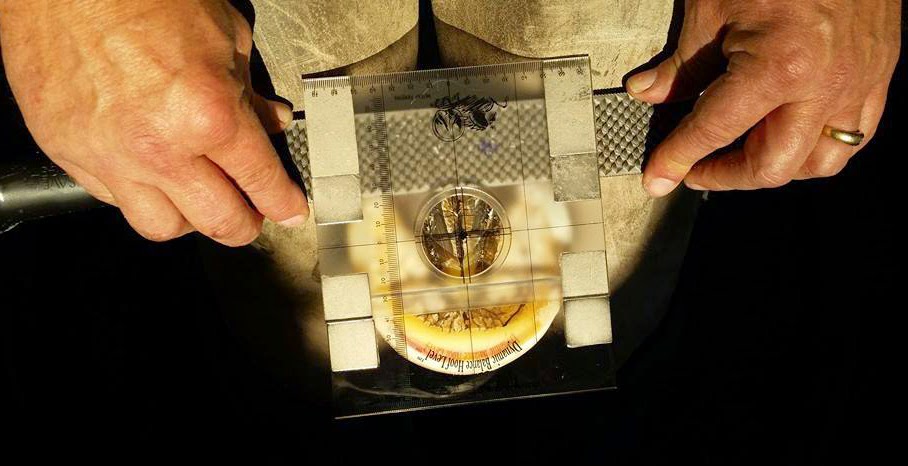

The Dynamic Balance Hoof Level was developed after nearly a decade of study. It provides a plane of reference that when followed achieves dynamic three dimensional balance of the hoof capsule to the axis of the internal foot. Recent studies indicate that achieving three dimensional balance about the axis of the foot supports symmetrical movement improving locomotion. The DBHL attaches directly to a farriers rasp. Three distinct planes are presented, the axis plane, the heel plane, and the toe plane. When the hoof is trimmed to the referenced axis plane, dynamic balance is achieved. A soon to be published paper references the importance of fore foot balance and the importance of balancing to the axis plane. The DBHL provides a reliable plane of reference for achieving accurate and repeatable balance.  www.hooflevel.com 

Sunday, December 14, 2014

Frog Function revisited

When you are asked what the function of the frog is what do you say? It's a pump, its for traction, its a shock absorber? Over the centuries we have come to accept the frog's function based on, for the most part supposition. There have been numerous studies done on the frog from many different perspectives, but I have not seen many that looked at the frog from my perspective.If the frog's primary function was to act as a pump then why the triangle shape? A simple question. Why has the frog not take on the form of a pad whose confirmation was closer to that of a half sphere? After all when I need to prime my Weed Eater I pump the little rubber half bubble on its carb, this conformation makes sense, but a triangle?
 One has to explore the foundations of the foot to formulate an understanding of why the frog is triangular in shape. In my video on foot function and in class I use a simple paper plate to help explain part of its conformation. On the paper plate I draw the solar structures of the hoof, then grab the area of the plate that represents the heels and attempt to distort the plate without causing distortion to occur at the area that represents P3 (the toe area). You will find that it can't be done. Now cut out the area represented by the frog, and attempt to do the same. Now you can induce distortion to the caudal foot, and the "V" known as the Frog Stay aids in isolating the distortion to the caudal foot, protecting the coffin joint and P3 from torque. Why? The foundations of the caudal foot are cartilage. Each of the lateral cartilages (Palmar Foundations) can distort independently of one another, providing elastic potential acting as torque arms to protect the dorsal foundation from torque (P3).
In an effort to define frog function it is important that you identify true conformation of the frog, including its distal surface and proximal surface. Many of the studies conducted do not take into consideration the proximal or axial surface of the insensitive frog. The proximal surface is where we find the Frog Spine. The Frog Spine function has not to the best of my knowledge been defined. In frog function studies at the Institute the frog spine is viewed as a dynamic structure that functions to direct the energies created during the stride.  From my perspective the primary function of the frog is to act as a vehicle for the delivery of stimulus to the appropriate structures within the caudal foot. Subscribing to this definition of frog function helps us to understand the correlation between health of the frog and health of the digital cushion, and ungluar cartilages. I recall closing my talk at the International Hoof Summit in 2006 with this statement "if you have poor health to the frog, you can't expect to achieve health in the caudal foot." Under run heels, poor bar conformation (frog stay conformation), contracted heels are all the result of weak structure due to lack of correct stimulus. Having a means to deliver correct stimulus to the structures of the caudal foot is paramount in developing health, and the frog is the primary vehicle for the delivery of that stimulus.

Tuesday, December 9, 2014

Spectrum of Usability

Day three of the Ocala Florida Level One Applied Equine Podiatry course. Working with cadaver limbs teaching Spectrum of Usability. The S of U is used to evaluate the hoof for health and conformation. We first developed our S of U in 2002.
The spectrum was developed for use by the Institute of Applied Equine Podiatry for a study being conducted to compare health and confirmation of a hoof to the position of P3 (coffin bone) in relationship to the ground plane. 50 cadaver hooves were obtained from a local rendering plant. Six structures of the hoof were rated for health on a scale of 1 to 9 with 1 being very poor and 9 being very healthy. Six structures scored: Frog, Sole, Heel, Bars, Quarters, and Toe. We then averaged the scores together to get an average score for each hoof.
We then proceeded to remove the hoof capsule being careful not to damage the internal foot (Internal Arch Apparatus). The internal foot was then placed on a glass panel, with the tip of P3 and the most distal points of the sensitive frog making contact with the plane. Measurements were then taken at the widest part of P3. We measured the space presented between the glass plane and the dermis at this point, both medial and lateral averaging the measurements together.
We then compared these measurements to the S of U score for each given hoof. Our findings were that the hooves that presented height from the glass plane to the dermis scored higher on the S of U than those that presented little to no height (ground parallel) at this location. This pilot study provides evidence to support the belief that correct conformation of the Ungular Cartilages aid in positioning the distal border of P3 within the capsule. It is our belief that when the ungular cartilage conformation is correct the distal boarder of P3 is at a 5 degree inclination to the ground plane.  It is our belief that those hooves with the lowest S of U scores present a caudally rotated P3.

Sunday, December 7, 2014

Passion for Learning, You gotta love it

Yesterday was the first day of the fall Applied Equine Podiatry course held in Ocala Florida. The coursed open with an introduction to the principles and phylosophies of Applied Equine Podiatry, following this up with teaching the basics of Physiological Sequencing. If you have been following this blog you may have taken notice that I refer to physiological sequencing often.
Today's class will continue with the defining hemodynamics and the Suspension Theory of Hoof Dynamics. Also of great importance in teaching AEP is to be certian that all students Have a clear understanding of Dynamic Equilibrium as it pertains to foot function, this allows for a shift in paradym. First time students are often overcome by feelings of, lets just say concern over the current lack of respect offered normal physology in the practice of hoof care. In the first two days of class students are exposed to: The Internal Arch Theory, the Suspension Theory of Hoof Dynamics, Hemodynamics within the foot, Physological Sequencing, the HPTModel, the Spectrum of Usability, and the HPTMethod. We do not expect first time students to retain all of this information. There are however key elements that first time students are instructed to take special note off, in the hope that this key information will be retained following completion of this, the first of their five practical courses. Each practical course is 40 hours, with one building upon the other. Horse owners that wish to be exposed to the basic principles of AEP will find attending one five day course very beneficial. All in all yesterday was excellent. Enthusiastic students, a positive learning environment, and a topic we are all passionate about, what more could you ask for?