Monday, January 18, 2016

Weighing in on Leg Action

Can a Horseshoe improve stride?

The following text is from an email I received concerning shod vs. barefoot. 
 
Hi
I have an 11-year-old Lusitano stallion that is working towards Grand Prix dressage.
I have owned him since he was 3 years old and he has never had shoes on.
My farrier says he has the best feet of any horse he has ever seen. So far so good, but my dressage trainer, a Grand Prix rider from Holland, is insisting that I must put shoes on him.
He says that it will improve his front leg action making him lift his legs higher in movements like passage.
Is he right?
Wouldn't it only be a temporary reaction to the weight of the shoes?
The numerous downsides surely outweigh the possibility of more action.
I respect my trainer but I really don't want to put shoes on him, but my trainer can't understand why not.
I would love to hear any comments you might have please?

Kind regards
Rosie
From the UK
 
My response:

Dear Rosie, 
Weight does have a huge effect on limb action, and yes, the weight of the shoe can alter gait. I have been a farrier for over three decades and in my earlier years, I worked on many Standardbred horses (Trotters and Pacers) using weight to alter or improve gait. Yes, I did say improve gait. I did not say improved biomechanics with the welfare of the horse in mind.
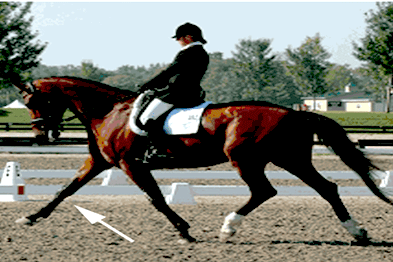
 
Targeted exercise results in symmetrical movement
Seeing you have a healthy shoeless horse, I would not recommend shoeing this horse with a traditional rigid horse shoe, as the benefits of its weight does not outweigh the negative effects of the loss of foot function.
There are other means of achieving the goals your trainer has set. When we wanted to alter movement of the limb in the race horse (Trotter), we would use weights such as toe weights, side weights, or heel weights. A strategically placed 2 oz. weight would have adequate influence over foot flight, likely more so than a horseshoe placed balanced about the foots' axis. These hoof weights are available from several suppliers via the internet. Your trimmer should also be able to use their imagination to develop weights that would be less conspicuous on the hoof.
These weights should be applied to the lower outer hoof wall with glue, or screw, where desired. This type of weight is far less detrimental to foot function, but be advised, anytime you attempt to alter limb movement, you are creating strain that could lead to lameness. In addition to weights, there are horseshoes that offer needed elastic potential for better foot function, one such shoe is the titanium horseshoe.
In addition to weights, some trainers use weighted bell boots to help in developing muscle and muscle memory. Proper exercise, targeting the appropriate muscle groups goes a long way in releasing a horse's potential. See photos above.
I hope this information will be useful, pointing out that there are always alternatives to the traditional ridged shoe.

Sincerely,

Keith "KC" La Pierre, MAEP, APR, RJF, CF, MIAEP

Monday, January 11, 2016

Immobilization or Stabilization?

The more we learn about the equine hoof the more we come to realize the importance of stabilization. The conformation of the hoof capsule becomes a wonder to behold when you examine each individual structure of its make-up. In my teaching I stress the importance of defining correct conformation and health of tissue for a given structure, knowing this enables us to define a structures function. The hoof wall in itself is composed of a number of structures, each being defined by its conformation and the make-up of its tissue.
When it comes to the hoof capsule, stability defines its health. The hoof wall is a matrix of epithelium and within that matrix are primary tubules originating at the coronary band and laminar derived inter-tubular horn originating at the lamellae.
The ratio of tubule to lamellae derived horn defines the walls primary function at any given location in the hoof wall. For example: The toe region of the hoof capsule has a high ratio of primary tubules to that of laminar derived horn, this when compared to the heel area of the hoof capsule. Primary tubules resist distortion, whereas lamellae derived horn is well suited to distortion and buffering. You see primary tubules provide the stability to the matrix much like re-bar to concrete. Primary tubules produced a the coronary band are quite dense.

Foundation, Foundation, Foundation 
We must look to the foundation of a structure to truly understand the why of its make-up. The foundation of the toe is the coffin bone, where as the heel has a foundation of cartilage. It is a fact that the foundation of the caudal (back) hoof is cartilage and the foundation for the dorsal foot is bone. With a high ratio of tubules to lamellae derived horn in hoof wall surrounding the coffin bone we can deduce that the function of the toe is one of support and protection. Not physical support, but rather to support locomotion. Protection comes in the form of stabilization, helping to reduce torque about the coffin bone and with a layer of lamellae derived horn between the coffin bone and the hoof wall matrix a buffer is created to protect the dermis.
Looking at the heels we find a foundation of cartilage. The hoof wall in the heel has a matrix comprised of a high ratio of lamellae derived horn to that of primary tubules. This ratio allows for distortion to occur in the caudal foot, while protecting the dermis by way of buffering the shock created at impact.
Why do we want distortion in the caudal foot? 
The simplest of answers is; because of the foundations of the foot. Cartilage throughout the body is often present to protect bone and this is true of the Ungular Cartilages of the equine foot. Cartilage health plays a major role in protecting the coffin bone and navicular apparatus from torque.
How did I come to this conclusion? By asking another simple question: Whys is the frog a triangle? Or Why is the Frog Stay a "V". As I stated earlier function is defined by a structures conformation and the property of its tissue. The foundation of the frog stay (inclusive of the bars) is essentially Ungular Cartilage. When I lectured at the National Farriers Conference in Normandy France I presented an analogy to help explain the function of the Ungular Cartilages.
I related the coffin bone to a tow vehicle and the ungular cartilages as a horse box (trailer). The union of the cartilage to bone was portrayed as a hitch with stabilizer bars. The function of the trailer hitch was to reduce or eliminate torque on the vehicle. The stabilizer bars (springs) provided elastic potential to stabilize movement and further reduce uncontrolled movement on the vehicle. Cartilage has the same function. Having a high elastic potential cartilage effectively reduces torque on the coffin bone and the navicular apparatus. I pointed out that stabilizer bars allow for optimal performance in towing and if they are removed excessive movement can occur placing strain on the vehicle. I also pointed out that if the hitch was to be welded solid the vehicle would be exposed to extreme torque and strain. I know this is a simplistic way of looking at function, but it often helps my students understand the difference between Stabilization, Instability, and Immobilization.
With this understanding my students are able to evaluate the vast array of bar shoes, flexible shoes, pad, and boots being used on horses today.
A foot stricken with instability due to weak cartilages will not do well in a flexible horse shoe, simply because unrestricted movement can be detrimental. Such a foot will not do well in a bar shoe either. The reason; because cartilage needs pressure to maintain or return health. Cartilage does not derive its nourishment directly from the circulatory system, so increasing circulation by loading the frog or allowing for expansion does not suffice. Cartilage needs to be stabilized not immobilized. How is this done? By providing stability through support with elastic potential. There are many products out there that can provide dynamic stability through elastice potentional to the weak hoof, using titanium shoes or steel (spring) shoes are two ways. The product pictured is  Perfect Hoof Wear, a polyester wrap. Our students learn that an unstable foot can be stabilized by using the PHW and adding a flexible horseshoe to the wrap
for performance.

Wednesday, January 6, 2016

Take a Load Off (F=M x A)

How Body Condition influences Hoof Care Practices.

by Keith "KC" La Pierre, MIAEP, APF, RJF

Being the first week of the new year my thoughts focus on maintaining or achieving better health in the coming year, this not only for myself, but for my horses and the horses in my care as well. 
Close observation of the horse's body condition helps in my preparations for upcoming seasonal changes, and the riding season. Experienced horse people know that a heavy winter coat can hide a multitude of issues. Changes in water intake, diet and exercise all result in loss of conditioning. Some horses lose weight, others gain weight. 
As an Equine Podiatrist the horse's body condition is important in determining a reasonable treatment protocol and prognosis. Because of this, body scoring is included in the DAEP's (Diploma in Applied Equine Podiatry) Spectrum of Usability
When first called upon to work on a horse I always conduct a thorough evaluation of the whole horse, not simply its hooves. Let me give you an example of how body scoring helps in determining my course of action.
There have been occasion when I have been called upon to pull horseshoes off of a horse, this usually by a horse owner that wants to go natural or barefoot. However, when I see the horse and complete a thorough evaluation, which includes body scoring (we'll give the horse a 8) and the Spectrum of Usability of the hooves (we'll give the horse a 2), I find that my recommendation must be; do not pull the shoes. In this example the recommendation was not made because the horse had a low body condition score, but rather a high body condition score. A high body condition score coupled with a low Spectrum of Usability score. In the practice of Applied Equine Podiatry we utilize the Spectrum of Usability to assess the capability the horse's feet have to deal with force. Each structure is assessed and rated on a scale of 1/9, with 1 being poorest, unlike body condition scoring 9 is healthiest. In body condition scoring 1 is poor, 5 is healthy and 9 is poor. The horse in this example scored high on the body score, which means it was overweight. Also in the example the horse scored low on the S of U. A low score on the S of U indicates a foot that cannot easily cope with excessive force, (a weak, unstable foot). You may be aware that Force = Mass x Acceleration. When assessing whether a horse's foot needs stabilization and to what degree, is in part determined by body condition. Fortunately we now have alternatives to conventional horseshoes, (immobilization). We now have products that offer dynamic stabilization, such as Perfect Hoof Wear. In the not so distant past the recommendation for the overweight horse that had unstable hooves would be to stay in shoes for the time being, get some weight off the horse and remove the shoes when the environment was best for rehabilitation (drier summer months for example). Today we can apply products that offer stabilization and correct stimulus for the return of health to weak unstable structures (hoof wall, heels, bars, etc), while allowing the horse to be placed into a weight loss and rehabilitation program. Every hoof care provider should be well versed in Equine Body Scoring and should utilize this knowledge to keep the horses in their care safe and sound. 
Here is a video/power point that will help you to better understand body scoring and how our graduates (DAEP) utilize body scoring to help in the rehabilitation of your horses hooves.


Thursday, November 19, 2015

Hoof Wall Matrix

The Matrix Loaded, Unloaded, Reloaded? 


by KC La Pierre


What on earth am I talking about? I'm about to expose you to the latest information on hoof wall health. Information that will, I hope change your entire perspective on hoof wall health.
For nearly a decade, I have taught the importance of inner wall health and the how inner wall health is vital to overall foot health. Where my explanation of hoof wall health may have been lacking is in the definition of the Matrix.
The Matrix The hoof capsule and the components that comprise it consist of zones (areas of differing matrix); each matrix is responsible for a multitude of functions. The Matrix is a blending, or combination of different types of horn that constitute a structure (hoof wall, sole, white line, or frog.) The outer hoof wall that you see consists mainly of horn tubules and provides protection against moisture loss and toxin ingress. It is also responsible for the storing of energy created by the stride, to be released during breakover. The outer wall must be strong and hard to resist the leverage forces that occur throughout the stride. The outer hoof wall however is only one part of a more complex matrix. The matrix of the hoof capsule is made up of tubules that originate at the coronary band. These tubules are bound tightly together by a specialized Intertubular horn that acts much like super glue. As we move deeper into the wall's matrix, we find horn produced by the lamellae blending with the newly developed tubules. This blending takes place just below the coronary band, in those areas covered by the periople. Periople is known as the stratum externum, and serves to protect newly developing wall. Progressing further inward, the ratio of tubules to Intertubular horn (horn produced at the lamellae) is reduced, until we reach the zone of matrix known as the stratum internum, also known as the inner hoof wall. This inner most hoof wall, often described as the water line, is far more pliable than the outer wall, and is well suited to distortion without breakdown. The inner most wall is easily identified by its lack of pigment. Research has provided strong evidence that the Intertubular horn of the inner wall originates at the laminae layer of the foot, and grows from the inside out, blending with the tubules of the outer wall to form the matrix. The healthiest of hooves contain a strong Matrix (blending) of both types of horn. The inner most wall having fewer tubules is far more pliable than the outer most wall. This inner most wall (Stratum Internum) acts as a buffer zone between the sensitive structures of the foot and the dense matrix of the hoof capsule known as the (Stratum Medium). When the foot is asked to distort, it is the inner wall's responsibility to absorb much of the pressure created by the lever forces created by the outer wall and stride. Our research points to poor matrixing as a primary cause for reoccurring hoof wall cracks, wall separation, and white line disease.
Cause and Effect After much research, the logical conclusion is that hoof wall disorders are most commonly seen in those horses where correct foot function is lacking. The need for proper balance and distortion is very important to proper foot function and the resulting matrix . As stated, the matrix that is characteristic of the healthy hoof occurs just distal to the coronary band, in those areas covered by the periople, and grows distal to the ground. There can be several causes for poor matrix to occur, and often it is a combination of causes.• Lack of distortion, most commonly caused by shoeing or lack of exercise.• Imbalance resulting in improper distortion.• Poor hydration, leading to acidity, and ph imbalances.• Compromised nutrition, and vitamin/mineral imbalances.• Compromised immune system, often resulting in infection of periople, and hoof wall.• Damaged periople, caused by toxins (toxic hoof dressings, shampoo, oils), or injury. Matrixing also occurs in other areas of the hoof capsule, including at the white line, frog, and sole. Wherever the mechanism needed for correct matrixing is lacking, areas of infiltration of bacteria and other micro-organisms can occur, this leading to horn failure (hoof wall cracks, wall separations, white line disease, frog infections, and sole cracking). Balance can play a huge role in hoof wall health. A weak matrix, coupled with imbalance in the shoeing process, cause excessive stresses to be placed on the hoof wall leading to cracks. It is not uncommon for the farrier to suggest removing the shoes for the winter, "to give the foot a break from shoeing." What often happens is that the foot is not given enough time to see a healthy matrix reaching the ground, and the wet spring environment plays havoc with the increased inner wall that is presented to the ground. The inner wall is very susceptible to infection when not matrixed correctly. With the matrix occurring higher up the hoof wall, it does need adequate time to grow down, and those hooves that do not present a strong matrix at the ground are more likely to develop infection, cracks and separations.
Treatments Now that we have a better understanding as to the cause of hoof wall problems, what can we do to cure or better yet prevent them? With the understanding that environmental stimulus (distortion) is responsible for the health of the matrix within the foot we can develop a treatment plan to cure an existing problem or develop a preventative strategy to prevent future problems. First and foremost, use a hoof disinfectant to rid the foot of harmful bacteria. I highly recommend a product called Clean Trax. Clean Trax is a deep penetrating hoof cleanser that is often effective in one treatment. Follow up with a daily treatment of Silvetrasol Hoof and Wound Wash, our non-necrotizing topical anti-bacterial solution. I recommend staying away from products that contain formaldehyde, bleach or other necrotizing ingredients. You may have come to the conclusion that I promote going shoeless for the health of the matrix, and for a foot with a hoof wall problem this is no exception. I have successfully treated toe cracks, wall separations, and white line disease shoeless for many years now. Though there are excellent products that can provide dynamic stability to the unstable foot.  I, like many farriers, have tried resections, patching, lacing, and corrective shoeing. Don't get me wrong, there will be times when the foot has lost so much structure that the only course of action is to stabilize the capsule. We now have Energetics Brand Perfect Hoof Wear for cases where stabilization is needed. A balanced stable foot that is exposed to the proper environmental stimulus (distortions) for the return of healthy matrixing will be a foot that is not likely to develop severe hoof wall issues. What is the proper environmental stimulus you ask? Exercise! Provided stability exist or can be achieved, hand walks over uneven surfaces will do wonders for the horse with a lack of horn matrixing. Balance in the foot is critical allowing for correct distortion to occur, thus providing the necessary pressure for correct growth and matrixing to occur. Often thirty minutes a day of hand walking for eight weeks will produce visibly healthy growth of the stratum internum (inner most wall). It should be noted that it will take several months for the hoof wall to fully matrix, as the matrix is formed just below the coronary band and must grow to the ground before it is evidenced.


Diet as a Factor
Evaluate your diet program. A well balanced diet will go a long way to developing a healthy matrix within the hoof capsule. It is best to consult with your veterinarian on dietary requirements for you horse, as requirements vary from region to region.
Regardless of the diet you have chosen for your horse, hydration is the most important factor in correct matrixing. Hoof wall cracks, and separations that occur in early spring can be signs of mild chronic dehydration having resulted in a poor matrix.
Conclusion
Your role in hoof care as an informed owner is to provide a dry, clean environment that is conducive to the health of the foot. Begin with a well balanced foot, treat for infection, and provide a balanced diet, plenty of water and exercise.