Monday, February 8, 2016

Cracking the Code to Hoof Cracks

Persistent Hoof Wall Cracks

Sand Cracks, Grass Cracks, Toe Cracks, Quarter Cracks plague so many horses that there is an entire segment of the hoof care product industry dedicated to producing products to treat them. A week does not go by that we do not receive a call or email concerning hoof cracks.
Just this week I received a call from a horse owner that wanted a second opinion on how the veterinarian suggested treating a persistent toe crack. Apparently she and her trimmer have been battling sand cracks on several of her horses for the better part of two years. In one case the crack had become so bad that the veterinarian prescribed a hoof wall resection be performed (treat instability with removal of that which is meant stabilize?). The owner was ordering Clean Trax, a deep penetrating hoof wash that works exceptionally well in the treatment of infections of the hoof wall. We received pictures and a small history in which to make our assessment. The type of hoof wall defect seen in this case was of no great mystery. 


The Cause
The truth of the matter is that the majority of hoof cracks seen are the result of poor hoof wall matrix development.

Having a strong understanding of how the hoof wall develops and the function of the hoof wall at any given location in the hoof capsule is paramount to treating hoof cracks. Yes, metabolism and nutrition are important to treating cracks, and for the most part owners of horses with persistent cracks have done their best to address these components. Then why is it that the cracks persist? I have already answered that; poor hoof wall matrix development. Yes, hoof wall matrix is affected by nutrition and metabolism, but the real culprit in persistent hoof cracks is the failure of the mechanism for the creation of a strong wall matrix.
The hoof wall matrix originates at the junction of the coronary band dermis and dermal lamellae. This area is identifiable by the manifestation of the stratum externum (Periople). Roughly speaking it is the top ten percent of the hoof capsule. It is in this area that the tubules produced at the coronary band matrix with the horn developed by the lamellae. The periople aids in slowing the keratinization process allowing for the migration of intertubular horn around and in between the primary tubules. The mechanism that makes this posible is “distortion”. Think of distortion as a kneading process creating the necessary pressures for the development of a healthy matrix. Wall function is determined by the ratio of primary tubules to that of intertubular horn (laminae derived horn and within the matrix the higher the ratio of tubules, the harder the wall (less resistant to flexion), the lower the ratio the more flexible. So what has this got to do with hoof wall cracks?
In many of the cases we see involving sand, grass or persistent toe cracks we have found that the fault has been that the mechanism for the creation of a healthy matrix was simply weak or faulty.

Just this week we met our new neighbor, a new home has just been completed adjacent to our property. The owner is a horse owner who has several horses. She is an avid dressage rider. Naturally the conversation turned to horses and their hooves. According to my new neighbor all of her horses suffer from persistent sand cracks.  The horses are stabled about 10 miles from this new property and would be moving here shortly. The owner asked how we prevented sand cracks. We have seven horses on our property here in SW Florida. The environment is less than ideal for horses, being extremely wet most of the year and the pasture is comprised mostly of sand (sugar sand).  The environment is identical to the environment our new neighbor has been stabled in for the past several years. Why is it that we don’t have problems with persistent cracks, but she does?

The answer in my opinion is quite simple, “Imbalance”. When a hoof is trimmed and it is not balanced, the mechanism for the development of a healthy strong matrix is compromised. Couple that with the dubbing of the toe (backing the toe up), cross hatching, or the application of a rigid horseshoe and you have the recipe for failure. For over eighteen years I have been treating sand, grass, and toe cracks successfully without applying shoes, lacing, staples, or acrylics. There are times when there is instability and dynamic stability must be achieved, but that type of stability is not found in acrylics, staples, or rigid shoes.

Treatment
The first step in the treatment of cracks is to achieve dynamic balance of hoof to foot. Balancing to what is called the Live Sole Plane (Axis Plane). You can use the Dynamic Balance Hoof Level to confirm balance; this tool offers a reliable plane of reference. 
Once balance is achieved treat infection. I recommend Soaking in Clean Trax, with daily follow up application of Silvetrasol Hoof and Wound Wash. If it is determined that the crack or cracks have resulted in unacceptable instability, then I recommend using Perfect Hoof Wear for several trim cycles.


I have said it more times than I can remember, if the mechanism for producing a healthy Matrix is comprised, then no supplement, drug, or dressing is going to help alleviate hoof wall failures. Sure you can attempt to hold it all together with a horseshoe, quarter clips, staples, acrylics, and a host of other products developed as Band-Aids for the dreaded hoof wall crack, but until the mechanism for the development of a healthy matrix (balanced dynamic distortion) is returned you are simply placing a finger in the dyke so to speak.

Evidence Based
Having been a hoof care professional for over three decades, and having graduates in eleven countries all applying the principles of dynamic balance we can say that we have a large sampling of horses that once suffered persistent hoof wall cracks, but no longer do.

If your horse is suffering from persistent hoof wall cracks, you may want to investigate Applied Equine Podiatry further by visiting www.equinepodiatry.com

Monday, February 1, 2016

What Hoof Model do you use?

 
As a professional hoof care provider and teacher I see hundreds of post that fuel the debate over the use of the Wild Horse as a model for hoof care. Whether you are a farrier, trimmer, or horse owner emotions can run high, especially with all of the media play the wild horses are receiving as of late. 

Many hoof care professionals have looked to these wild horses to develop a model for trimming the domestic horse's hooves. 

Feral Abaco Barb
I too have explored the possibility of using the hooves of the wild horse as a model for the treatment of the domestic horse hoof. My research evolved into a study of environment and how the hooves of the wild horse developed as a result of breeding, diet and overall environment. But even before I went afield to work among feral horse, I had disqualified the feral horse hoof as a model, this because of the law of physics;  F = M x A.

Shoeless
Remember, I am discussing the development of a hoof model for the treatment methods of the domestic horse. What is a model? In the practice of Farriery or hoof care the model defines the foot, not simply the hoof. Indulge me while I offer an analogy; I really would love to own a Ferrari. Years ago there were kits to transform a Pontiac Fiero into a Ferrari look alike. With this kit I didn't need to know the mechanics of the Ferrari to build a car that looked like one. But, the reality is that it would not perform like one if I simply mimicked the way it looked. I know that this comparison is a bit simplistic and silly, but it does make a point.


Developing a model that must deal with the increased forces generated by domestication requires knowledge of the internal structures of the foot. That is where the definition Structure + Function = Performance comes into play. There are several theories on energymanagement and foot function that have helped in the development of a model for the practice of farriery. The feral hoof model however came out of the search for a model without the forethought of foot function within a domestic environment. As a result, those proponents of the natural trim model have been searching to find foot function theories to support its use in the treatment of the domestic horse for over twenty years. The more we learn about the equine foot and foot function the more we learn that its health is governed by a few steadfast laws, and one is F=M x A.     

Tuesday, January 26, 2016

Weighing in on Obesity and Applied Equine Podiatry

My poor horse's aching feet.

Obesity is not a condition usually associated with hoof care. It is however, a major cause of Deformed Hoof Syndrome (DHS) and loss of proper foot function. Many of today's horses suffering hoof ailments are often overweight.
How do we define the obese horse? The obese horse is one that is 150 to 200 pounds over its recommended weight, this determined by weight tape and the application of the Body Condition Scoring System (BCS).

The BCS System
Score of 1(poor) to 9 (Extremely Fat)
Developed by Henneke et al in 1983 at Texas A&M
Used throughout the horse industry as standard score system
Accepted scientific method
Admissible in court

How it is done
Focus on 6 key areas:
Neck
Withers
Spinous process
Tail head
Behind the shoulder
Ribs

The system utilizes Visual Appraisal and Hands On /Palpation of those areas exhibiting fat deposits listed above.


As a Applied Equine Podiatrist I am concerned with horses that score 7 or higher on the BCS.

BCS 7
BCS 7
May have crease down back. Individual ribs can be felt, but noticeable filling between ribs with fat. Fat around tailhead is soft. Fat deposits along withers, behind shoulders and along the neck.

BCS 8
BCS 8
Crease down back. Difficult to palpate ribs. Fat around tailhead very soft. Area along withers filled with fat. Area behind shoulder filled in flush. Noticeable thickening of neck. Fat deposited along inner buttocks.

BCS 9

BCS 9
Obvious crease down back. Patchy fat appearing over ribs. Bulging fat around tailhead, along withers, behind shoulders and along neck. Fat along inner buttocks may rub together. Flank filled in flush.

Rehabilitating the obese horse with Deformed Hoof Syndrome (DHS) is far more difficult, than a horse that is carrying correct weight and condition. The added weight hinders the horse's ability to protect itself from injury, and those structures responsible for suspension within the foot are often stressed to their maximum sustainability. Solar bruising is common, this because those structures responsible for suspension are just simply over stressed and downward movement of the bones of the foot are not properly held in check. The result is excessive pressure and force being applied to the solar dermis. 

When I receive a request to remove horseshoes from a horse, with the goal being a sound shoeless horse it is my responsibility to determine the level of usability of the structures of the foot. I do this by utilizing a Spectrum of Usability (published by IAEP, Inc.) and BCS. I then take into account the added force the foot must endure as a result of the overweight condition.  In many instances I find it necessary to recommend some form of orthotics that will offer support and provide dynamic stabilization. 

Taking responsibility for the health of your horse's hooves involves conditioning the whole horse. Be responsible and don't simply pull those horseshoes, not without first determining the true state of health of the foot within. Learn to use both the BCS, and the Spectrum of Usability.

About the Author:
Keith "KC" La Pierre has been a professional farrier for over 33 years. He is the Co-Founder of the Institute of Applied Equine Podiatry, and developer of the Spectrum of Usability. He teaches and lectures both in the USA and Abroad. For more information and articles by KC La Pierre visit the Institutes website at www.equinepodiatry.com 

Monday, January 18, 2016

Weighing in on Leg Action

Can a Horseshoe improve stride?

The following text is from an email I received concerning shod vs. barefoot. 
 
Hi
I have an 11-year-old Lusitano stallion that is working towards Grand Prix dressage.
I have owned him since he was 3 years old and he has never had shoes on.
My farrier says he has the best feet of any horse he has ever seen. So far so good, but my dressage trainer, a Grand Prix rider from Holland, is insisting that I must put shoes on him.
He says that it will improve his front leg action making him lift his legs higher in movements like passage.
Is he right?
Wouldn't it only be a temporary reaction to the weight of the shoes?
The numerous downsides surely outweigh the possibility of more action.
I respect my trainer but I really don't want to put shoes on him, but my trainer can't understand why not.
I would love to hear any comments you might have please?

Kind regards
Rosie
From the UK
 
My response:

Dear Rosie, 
Weight does have a huge effect on limb action, and yes, the weight of the shoe can alter gait. I have been a farrier for over three decades and in my earlier years, I worked on many Standardbred horses (Trotters and Pacers) using weight to alter or improve gait. Yes, I did say improve gait. I did not say improved biomechanics with the welfare of the horse in mind.
 
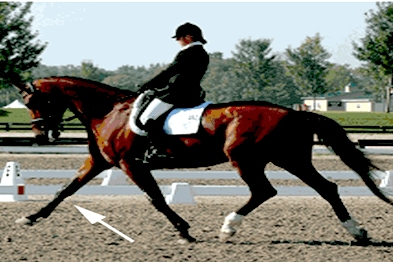
Targeted exercise results in symmetrical movement
Seeing you have a healthy shoeless horse, I would not recommend shoeing this horse with a traditional rigid horse shoe, as the benefits of its weight does not outweigh the negative effects of the loss of foot function.
There are other means of achieving the goals your trainer has set. When we wanted to alter movement of the limb in the race horse (Trotter), we would use weights such as toe weights, side weights, or heel weights. A strategically placed 2 oz. weight would have adequate influence over foot flight, likely more so than a horseshoe placed balanced about the foots' axis. These hoof weights are available from several suppliers via the internet. Your trimmer should also be able to use their imagination to develop weights that would be less conspicuous on the hoof.
These weights should be applied to the lower outer hoof wall with glue, or screw, where desired. This type of weight is far less detrimental to foot function, but be advised, anytime you attempt to alter limb movement, you are creating strain that could lead to lameness. In addition to weights, there are horseshoes that offer needed elastic potential for better foot function, one such shoe is the titanium horseshoe.
In addition to weights, some trainers use weighted bell boots to help in developing muscle and muscle memory. Proper exercise, targeting the appropriate muscle groups goes a long way in releasing a horse's potential. See photos above.
I hope this information will be useful, pointing out that there are always alternatives to the traditional ridged shoe.

Sincerely,

Keith "KC" La Pierre, MAEP, APR, RJF, CF, MIAEP