Wednesday, May 13, 2015

Evidence Based Farriery

Evidenced Based Farriery? by KC La Pierre, MIAEP, MAEP, APF, RJF, CF

Over the past month, graduates and students of our school, The Institute of Applied Equine Podiatry, have sent inquires voicing concerns over an article that was published in The Horse magazine. The article;" Evidence-Based Farriery: The Proof is in the Hoof" By Erica Larson, News Editor Apr 15, 2015. This article voices the opinions of several veterinarians concerning their take on the practice of evidenced based farriery. The question posed by our graduates; Don't they know that Applied Equine Podiatry is based entirely on evidence based farriery? comes up frequently.   Each time I would read such an email I found myself holding back a smile.
Why don't they know what we teach? The answer to that question is actually quite simple. Within the conventional veterinary/farrier industry, our work has always been lumped in with the barefoot movement. Why? Because our studies and teaching focus on foot structure, function and performance with little emphasis placed on the application of horseshoes. This is true of our entry level program. In our advanced level program, horseshoeing and digital orthopedics is an integral part of learning.
With that being said, it never ceases to amaze how acknowledgments can be found in the strangest of places. After nearly 15 years of teaching foot bio-mechanics and dynamics with little interest shown by the conventional veterinary sector, it was refreshing to see a leading Equine Podiatrist Stephen O’Grady, DVM, MRCVS state in the above mentioned article, “You can take biomechanical principles and establish the center of rotation in a horse’s foot. You can trim the horse’s foot according to biomechanical principles, and that way you can put some standardization into each trim. That’s evidence-based because … we have the support saying that biomechanical forces can be applied to the horse’s foot and therefore used as guidelines in trimming.”

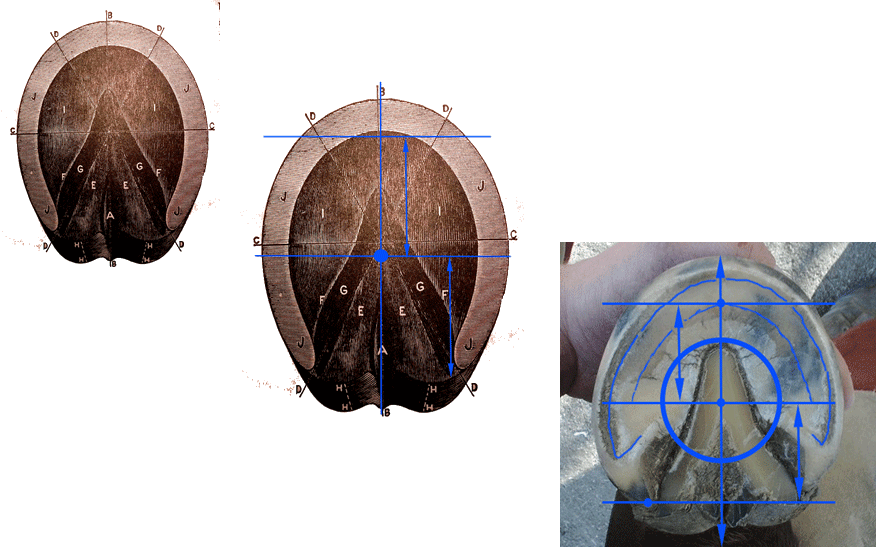
Note: The use of the Dynamic Balance Hoof Level is supported by O'Grady's above statement. We have taught that standardization (consistency) can be achieved by balancing to the center of rotation on all planes, simply stated; balancing of hoof capsule to the foot within , while the the biomechanical forces applied to the horse's foot should be viewed as the stimulus for the development of structure.
Essentially, all of what O'Grady proposes is being taught at the Institute and has been for nearly 15 years. In fact, the very cornerstone of our teaching underpins the definition; Structure + Function = Performance.
Our curriculum includes an in-depth study of the structures of the equine foot and their functions, and physiological sequencing.  In 2000, we began teaching the Suspension Theory of Hoof Dynamics, a theory grounded in evidence based farriery, Bio-mechanics and Energetics within the foot are all addressed. Several of the papers referenced in the article in The Horse were used in support of the development of this foot function theory, along with hundreds of other credible papers. New research is evaluated from a perspective of evolution.
Also in the same article was written, O’Grady believes researchers need to focus on “evaluating the horse’s foot, evaluating the structures in the foot, the appropriate trim, and finding your way about the foot.”
In 2001 we introduced the use of the Spectrum of Usability, a tool that is used to asses the health of the structures of the equine foot. In 2014 at the Veterinary Conference in Poa, France, a well-known farrier presented the Spectrum of Usability proposing it be used by farriers and researchers alike.
Here is just one of the many power points we utilize in teaching the use of the Spectrum of Usability; Assessing Structures


Our program has been completed by veterinarians, farriers, and students entering into a new career. We are encouraged by the fact that we have graduates in over 15 countries, all of whom practice the principles of Applied Equine Podiatry. With over 15 years of scrutinizing and continued re-evaluation of curriculum content, we can say with confidence that the fundamentals taught at the Institute are grounded in evidenced based farriery, even though we don't teach forging. Thank you Stephen O’Grady, DVM, MRCVS for offering up your definition of what constitutes Evidence Based Farriery. It is refreshing to see that lateral thinking has a unique way of infiltrating even the most vertical schools of thought.

Friday, March 6, 2015

High Heels and Laminitis

High heels or Conformation Change?

I recently read a thread on Facebook about rotation of P3 and high heels. The question presented was; Why is it that there seems to be a greater degree of rotation to P3 (coffin bone) in those hooves with high heels? It has often been said that horses that suffer laminitis/founder grow more heel. There are many reasons given for this, but none have been scientifically proven. Many of the treatment protocols call for raising the heels of those horses with rotation. From one perspective the farrier is looking at the hoof wall of the heel and its height. One farrier commented that heel height held no relationship to the position of the coffin bone. From another perspective the vet looks at bone alignment to the dorsal hoof wall. Perhaps it is time to entertain a new perspective, one that involves the conformation of the foundation caudal (back) foot, ungular cartilage. Here is a link to a paper I authored on the subject (Laminitis / Founder).  It is my hope that for the good of the horse those that are caring for the horse stricken with laminitis / founder look at the situation from multiple perspectives. Article on heel displacement

The lines do are NOT suggested as trim lines. They represent the
changes in conformation that have occurred over time. 


View this Video


About the Author: 
Keith "KC" La Pierre, MAEP, APF, RJF, CF has been a farrier for more than 30 years. KC is the co-founder of the Institute of Applied Equine Podiatry. KC teaches and lectures on Applied Equine Podiatry through out the world. As a researcher KC has developed and introduced dozens of innovative theories, methods, and products that continue to improve the quality of life of the horse. 

Friday, February 27, 2015

Frogs just don't survive in Oil.

As a professional farrier, teacher, and public speaker I am often asked what I use for treating hoof infections. My response has been; use a non caustic topical or soak that wont result in excessive moisture retention. I also suggest they do their homework before shelling out their hard earned money.

You should always be sure that when you purchase a hoof infection fighter you do your research, comparing apples to apples as a rule of thumb. Bacterial kill time and the effect the product has on moisture balance or retention is of great importance. Many oils that are purposed for use in treating infection (organic or synthetic) are known for their emulsifying properties, properties that aid in moisture retention. Excessive moisture retention has been found to be a cause for the breakdown of the protein bonds responsible for healthy horn development.
Further, there are several factors that can cause an infection to continue such as increased moisture, availability of nutrients for microbes to feed upon (necrotic tissue), and a warm environment. If a product perpetuates any of these factors it is likely not the most effective infection fighter available.

Around the middle of the 20th century it was common to hear of someone using used motor oil on their horses hooves. It was cheap (read free) and killed infection (very little could survive in the acidity of used motor oil).

Today many are turning to essential oils or extracts because of their natural ability to fight infection, often claiming they are cheaper than those products developed specifically for fighting hoof infections. This is often far from the truth. An Internet search for Tea Tree Oil revealed cost ranging from 14.95 oz. to 45.95 for 16 oz. How about Grape Seed Oil, is it cheaper? An Internet search for pure medicinal grape seed extract resulted in cost ranging from 9.95 for 3.5 oz. to 22.50 for 16 oz. You can always find cheaper oils, but it usually means you are getting inferior grade oils with contaminates or those thinned with additives.  Here is a link to those products that I use and recommend for use in fighting severe hoof infections. I have spent the better part of ten years developing these products to be safe and highly effective. So the next time someone post a comment suggesting you use an oil for hoof infections in place of those products developed for treating hoof infections, consider whether it truly is more cost effective. After all it is the health of your horse that is at stake.


About the Author: 
Keith "KC" La Pierre APF, RJF, CF, MIAEP has been a farrier for more than 30 years. KC is the co-founder of the Institute of Applied Equine Podiatry. KC teaches and lectures on Applied Equine Podiatry through out the world. KC has developed and introduced dozens of innovative theories, methods, and products that continue to improve the quality of life of the horse. 

Wednesday, February 25, 2015

Frog Function?

How important is the Frog and what's it supposed to do anyway? 

Whether you are a hoof care professional or a concerned horse owner this simple question is probably one that has come up often. With over 30 years as a professional farrier, now teaching both in the states and abroad you would think that I would find that those involved in caring for the horse's hoof would have the answers to these questions and that there would be agreement in how it were treated. That's what you would think right? But for reasons that sometimes allude me that is not the case. 

The importance of the frog and its function will depend largely on your perspective and your level of understanding of hoof function. Having studied hoof/foot function for the better part of 30 years from the perspective of; what is foot function with and without the constraints of horseshoe? When I say that I have dissected thousands of frogs you may experience flash backs of your time spent in high school biology class and recall the smell of formaldehyde. That's not quite how one goes about dissecting the horse's frog. My dissections began with asking questions, simple questions based on commonly accepted theory. What are some of the commonly accepted theories you ask? 
  • The frog is a pump aiding in circulation
  • The frog aids in traction because of its unique triangular shape
  • The frog is a shock absorbed because it is softer than the hoof wall and more rubber like.
  • The frog works with the digital cushion to help in foot expansion to aid in circulation
Please take note that I qualified the question with the word "theories". Theory is simply a hypothesis or an assumption based only partially on fact. I believe that the reason we have not seen much research done on the function of the frog is because the theories on hoof function are vague and to simplistic. I have stated it hundreds of times, "The greatest problem facing today's farrier is their complacency with simplicity." 
I will admit that frog function in of itself can be simply explained, this provided you have a working knowledge of the hoof function model it relates to. If for example your foot function model is based on circulation, then the frogs primary function will likely involve aiding in circulation. If your model is based on shock absorbency, then the primary function will be shock dissipation. You get the drift. 
When I first asked the question; what is the frog's function? I was in the midst of investigating hoof function. I was never satisfied with the simplistic hoof function theories I was asked to accept. I have a tendency to challenge conventional thinking and the way I challenge it is by asking very simple questions. These questions were always based on a definition I learned while working as an assistant to Master Blacksmith Paul Spaulding of the Cooperstown Farmers Museum in upstate New York some twenty years ago. The definition is Structure + Function = Performance (S + F = P).
Armed with this definition I began to question conventional and sometimes the not so conventional hoof theories of the day. 

My line of questioning was simple. Here are a few examples of such questions:
  1. If the frog is meant to be a pump why is it shaped like a triangle, why not more like a half sphere or pad?
  2. If the frog is meant to be a pump then why does the frog spine exist, a dense shark fin like appendage that  resides below and behind the DDFT? 
  3. If the frog is meant to aid in expansion then why in the healthy foot is the frog spine denser than the surrounding frog horn? 


Applying the definition to the frog and each of the structures of the foot allowed for the development of the "Suspension Theory of Hoof Dynamics", a comprehensive foot function theory. So what is the function of the frog? In my humble opinion it is the primary vehicle for the deliver of stimulus to the caudal (back) aspect of the foot, this allowing for the correct distribution of energies to the ungular cartilages. The Frog's shape and the shape of the frog stay (V in sole) protect the coffin joint and P3 from excessive torque created at impact by allowing for the correct function of the ungular cartilages. The functions of the frog are many, but can be defined as:
  • "Support"; supporting physiological function by acting as a vehicle for the delivery of stimulus to the caudal foot (energy management).
  • "Protection"; by aiding in the distribution of energies created by the stride.

To learn more about the Suspension Theory of Hoof Dynamics and Frog function visit our website at www.equinepodiatry.com