Copyright KC La Pierre © 2001
The HPT Method was developed in direct response to the Suspension Theory of Hoof Dynamics (La Pierre, 99). It is the author’s belief that this theory closest represents the true bio mechanics of the hoof. As the theory was forming, it became increasingly apparent that how the hoof dissipated the energies created during impact played an important role in keeping the horse sound, as did the utilization of the energies created to execute the stride. As with any object subject to kinetic energy, its shape is what determines where the energies are directed, thus hoof conformation and how a trim was applied appeared to be of greatest importance.
That said I find it important that I respond to a statement that has been presented recently more than once. The statement simply put; “The HPT is just the same as any other traditional trim, just applied well and that’s why the horses on it are going sound.” This statement has been echoed on many of the farrier and barefoot chat rooms from farriers all over the globe, including a select few from the UK and Sweden.
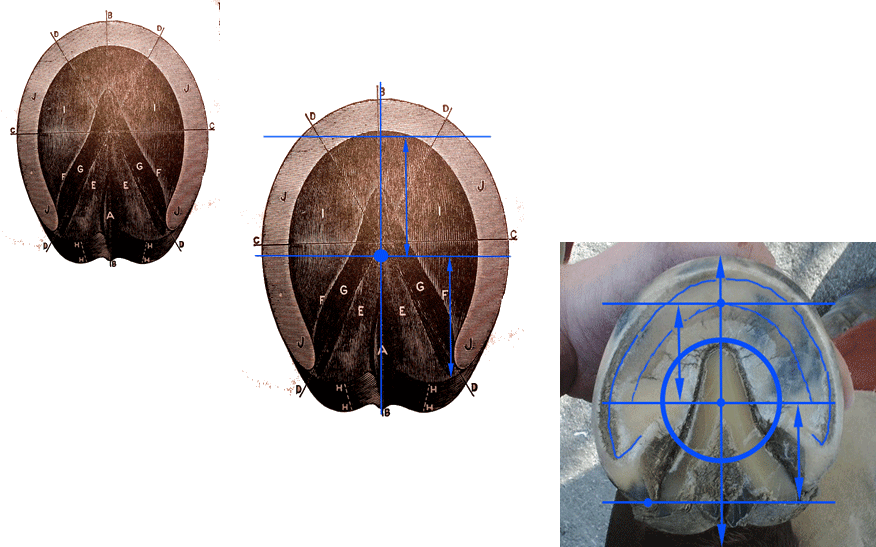
First, I will say that the HPT does not resemble the traditional wall bearing trim, but that is not what makes the HPT unique. What does make the HPT unique is the Method, the term HPT should not be used without its association with the term, Method. The HPT Method in itself is a tool we use to achieve proper structure in the hoof while practicing Applied Equine Podiatry.
For centuries, the farrier student has been taught how to apply the traditional trim to the horse. The method of teaching a traditional trim varies greatly among teachers and schools. This has led to an inherent problem; having a multitude of difficult to define reference points being left to the interpretation of the student. Applying a trim cannot be compared to mechanics or mathematics, it is not simply completing the formula or outlined task, and there are few true absolutes. Applying a correct traditional trim depends on one’s ability to correctly reference a multitude of factors that we have been taught were important to achieving balance in the hoof. None of these can be defined as absolutes, but have been misinterpreted as such. Angle of hoof is one such absolute that has been badly misinterpreted. In an effort to justify that which the student has interpreted, they are led to believe various measuring devices have been used to confirm what is being perceived as an absolute.
Thus, absolutes are perceived by the person reading the protractor, dividers, tee squares and rulers. It is impossible to state an absolute such as hoof angle and then expect anyone to use a device that uses undefined reference points to achieve the same. The protractor and dividers for instance, use reference points that are vague; therefore, any absolute perceived is based solely on the user’s interpretation of these points. Example: dividers use the hair line and protractors use dorsal wall and sole surface, all of which can be deviated to the point that the only absolute that can be stated is that neither can be measured accurately with these traditional tools. Further, traditionally we are taught to use external angles to guide us in applying a trim. Such angles involve shoulder to pastern angle in relationship to the hoofs’ dorsal wall angle. Is this an absolute? What about dorsal wall angle to heel angle and hairline to ground as so on and so on and so on?
It is true that with years of practice and experimentation, the farrier can capably apply a correct trim. This is a statement often used in defense of the traditional farrier sciences. “Leave it to the experts; it takes a long time to learn what is needed to trim a hoof properly or to treat hoof lameness.” There are some farriers out there that have the ability to interpret or read a hoof and apply a proper trim. Most of these farriers have taken many years to get to the point where they can make this claim and the percentage to those that can not is overwhelming, in my opinion. What of the thousands of horses being used to gain this expertise?
Just as we have seen a misinterpretation of the many natural trims being practiced, how the traditional trim is applied has been misinterpreted to a far greater extent. By having so many variables being left to one’s individual interpretation, it is little wonder there has been such difficulty in defining the proper trim. Therefore the true definition of a proper trim should be defined by the results obtained – a sound horse.
The inherent problem is that the traditional farrier science does not provide a solid method for teaching the application of the traditional trim and further, does not scientifically support its efficiency in its aid to the shoeing process. Yes, there are outlines on how to trim a hoof; many are mostly based on ones ability to visualize what lies beneath, (bone structure) and what is proper for balance. Dr. Doug Butler, author of “The Principle of Horse Shoeing III,” and renowned educator, stated recently in the American Farriers Journal that most farriers have difficulty visualizing the internal bone structures and their relationship to the hoof capsule. I find this remark to be of paramount importance, if the method for doing a traditional trim is based on one’s ability to interpret so many variables and the experts are finding it difficult, then my belief that there is an inherent problem has been confirmed.
The HPT Method, though not developed to answer the above outlined problem, does to a great extent do just that. As stated earlier, the HPT Method was developed as a result of my beliefs on how the hoof deals with force. The trim is applied using far fewer reference points and those being used, easily define balance as outlined by the traditional farrier sciences. It further answers a more important need; the need for a method that can be taught to a student and allow that student to obtain a proper trim. Proper trim defined by the results – a sound horse.
If the farrier sciences and their advocates were to continue their assault on the natural hoof care movement and the many trims being practiced, it would be advisable that they first define the methods used in teaching the traditional trim and aim at educating the professional at large.
The true issue here is not whether a horse can go barefoot or not, it is whether or not a horse is sound for its intended use. If a horse is shod and is lame, it may well be the trim. Does this mean the horse should go without shoes? This depends on hoof conformation and whether or not the HPT can be applied to improve the overall conformation of the hoof.
It is my belief that the hoof conformation cannot be corrected with the application of a shoe and that the remaining structure and its provided environment is the determining factors in whether or not the hoof can be corrected. Can a hoof be deviated so badly that it cannot be corrected? To say no would be irresponsible of me. There are hooves that have been deformed either by man or by accident that cannot be corrected by just a trim. You will notice that I did not say by nature. God provides, man interferes, and accidents happen. Someone recently asked me for percentages, not numbers and that is fair. I have found that 7 out of 10 horses that had owners interested in having their horses go shoeless were capable of doing so. Also, I have found that 8 out of 10 horses that came to us for treatment for lameness have shown marked improvement over their being shod with therapeutic shoes. Were all the shoes applied incorrectly? By what and who’s standard? It was more important that I determine whether or not the hoof conformation was a cause for lameness, and then decide on how best to improve the situation. Simply stated; the HPT Metho is a means by which a person can learn to apply a proper trim that has shown promise in the treatment of lameness associated with poor hoof conformation, as well as proving to be a trim for the high performance horse in many cases. Is the HPT just a traditional trim being applied well?
The answer is no, the HPT is a method being used to apply a proper trim in order to promote proper structure:Applied Equine Podiatry
About the Author:
KC La Pierre, a horsemen for over three decades, a graduate of Brewer School of Harness Racing and holder of a USTA trainers license in the early 80’s. He became a professional farrier after becoming dissatisfied with the work being performed on his own horses.
KC has been a professional farrier for nearly 33 years, certified with the AFA since 1989, passing their Journeymen written exam in 1990 and a Journey member of the Guild of Professional Farriers. After working 11 years at doing it traditionally, KC felt something was missing. He began to think that by increasing his forging skills he would be able to produce therapeutic and finely crafted hand made shoes to help in his rehabilitation of the deformed hoof and the lame horse. To this end, in 1994 he began an apprenticeship as a Traditional Blacksmith at the Farmers Museum in Cooperstown, NY under the guidance of Master Blacksmith Paul Spaulding. Two years later, armed with his improved forging skills, KC began applying hand made shoes of all types, only to come to the conclusion; the shoe was not the answer.
It turned out to be the teachings of the Master Smith, KC had learned to break things down to the simplest denominator and determine how things worked before forging them. It was this mindset that allowed KC to look closely at the hoof and determine that the answers were to be found on the inside. The results; Equine Podiatry based on The Suspension Theory of Hoof Dynamics and the HPT Method. KC is the Co-Founder of the Institute of Applied Equine Podiatry, Inc., which provides horse owners, vets, and farriers hands-on workshops to learn Applied Equine Podiatry as well as a three level certification program for becoming a DAEP. KC now teaches throughout the United States and abroad. His environmental research includes the wild horses of Abaco, Bahamas and many others.
IAEP, Inc.
KC La Pierre
www.equinepodiatry.com